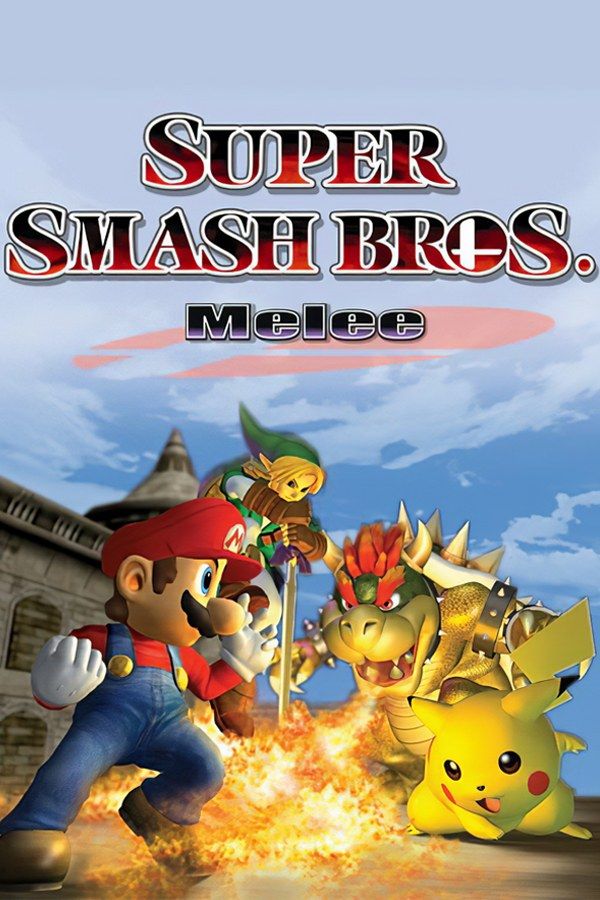
HAL Laboratory’s 2001 fighting game puts Nintendo’s characters on one stage and asks you to knock each other off it. Every hit raises a fighter’s damage percentage, and the higher it climbs, the farther the next hit sends them flying. If you own Melee, Nagori lets you play it on iPhone and iPad.
What you need
- An iPhone 12 or newer, or an iPad with an A14 chip or newer, with iOS 17.6 or later.
- Nagori from the App Store. Your first game is free.
- A disc image of your copy of Melee:
.iso,.gcm,.rvz,.cisoor.gcz, or a.zipor.rarcontaining it. The game fits on a single disc.
No BIOS file is needed.
How to play Super Smash Bros. Melee on iPhone
- Install Nagori from the App Store.
- Copy your Melee disc image to the Files app, in iCloud Drive or On My iPhone.
- Open Nagori, tap + and select the file. Add GameCube games from inside Nagori: the Files app’s Open in menu doesn’t hand formats like
.rvzand.gcmto Nagori. - Find Melee on the GameCube shelf and press Play.
- Switch to a touch layout with a stick. The default Standard layout has no stick, and Melee is played on one. Pause, open Settings → Touch Layout and choose Stick Focus for a large stick, or Twin Sticks to get the C-stick as well. With a controller connected, you can skip this step.
Controls
Melee lives on the control stick. Tilt it and press A for a tilt attack, or flick it and press A for a smash attack. The C-stick does smash attacks on its own, and in Nagori it’s the right stick: on a controller, and in the Twin Sticks and DualShock touch layouts. If the buttons feel cramped, open Edit Layout in the pause menu and move or resize them.
With a controller, A is the bottom face button, B the left one, X the right one and Y the top one. Z, for grabs, is on the right shoulder button, and L and R are the triggers. Press the left stick to open Nagori’s pause menu.
L and R register as full presses. That covers shielding, rolling and air dodging, but the light shield you get from a half press on a GameCube controller isn’t available.
Saves: memory card and save states
Melee saves to the memory card by itself: unlocked fighters and stages, trophies and your records. The in-game memory card works in Nagori as it did on the console. It stays inside the app, though: it isn’t in the Files app, isn’t part of Export Saves and doesn’t sync to iCloud.
Nagori adds two things on top:
- Quit any time. Leave the app mid-match and Continue puts you back exactly where you were.
- Save states. Pause and choose Save before a hard Event Match or the end of a Classic run, then Load to try again. Nagori keeps your last four saves per game.
Treat the memory card as your main save: a save state may not load after some Nagori updates.
Best settings
Open the pause menu and go to Settings → Quality. GameCube games work an iPhone hard, and this setting trades frame rate for heat:
- Low keeps the device coolest, at a lower frame rate.
- Medium, the default, is the place to start.
- High gives the smoothest motion and is meant for the newest iPhones and iPads.
Melee is a fast game, so try High on a recent device and step down if it gets hot. Nagori shows GameCube games at their original resolution, and Full Screen stretches the picture to fill the display.
One player only
Melee is best known as a party and tournament game for up to four players. Nagori plays GameCube games with one player, so you can’t fight friends on the same iPhone or iPad. What you get is the single-player side of the game: Classic, Adventure and All-Star, Event Match, the Stadium modes (Target Test, Home-Run Contest and Multi-Man Melee), Training, and VS. Mode against computer-controlled fighters. The controller doesn’t rumble in GameCube games.